

She is four years old. She has been on daily allergy medication for two years. The vet calls it atopy and writes the script and the script keeps the itch at zero. Underneath, a story is being written into her skin: a thickened patch on her belly, growths the vet says not to worry about, ear scratching that never quite stops.
He is older. His liver enzymes have been climbing across every bloodwork panel for three years. His lymphocytes have been below normal since 2023 and no one has connected the dots. He has been hospitalized once. He keeps eating what the bag tells you to feed him.
He is small, and he is in crisis. The food sensitivities were managed for years on immunosuppressants. The intestinal inflammation was on the ultrasound report nobody acted on. Then a tick bite while on monthly preventive cracked the system open, and now he is on six medications at once with liver enzymes nearly five times the upper limit.
Three different dogs. Three completely different presenting pictures. One identical underlying mechanism.
If you have ever sat across from a vet who told you everything looked fine while the dog in front of you clearly was not, this is the article that explains why.
The sentence that changes everything
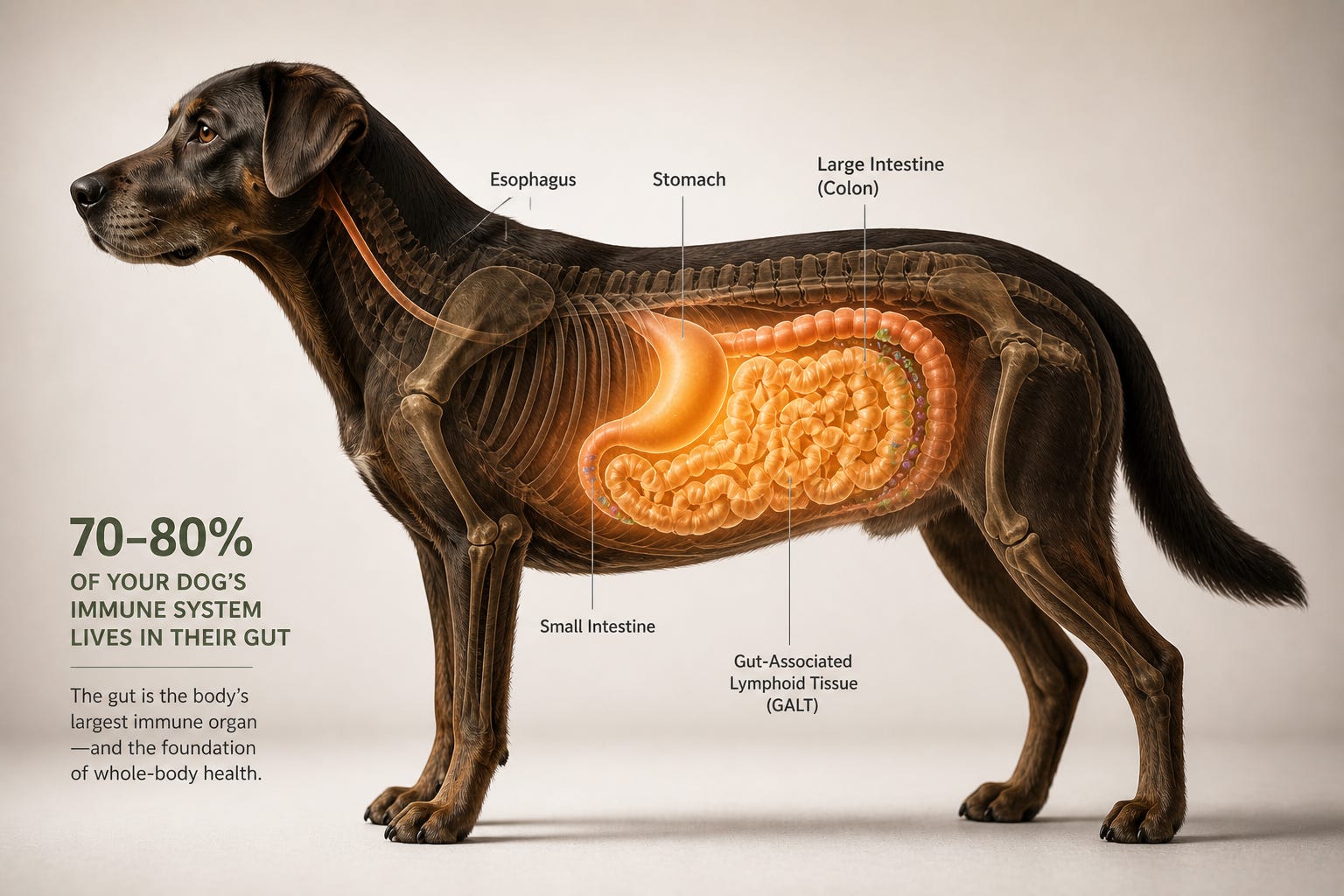
Approximately 70 to 80 percent of your dog’s immune system lives in the gastrointestinal tract.
That is not a metaphor. There is an actual anatomical structure called the gut-associated lymphoid tissue, or GALT, woven through the intestinal lining. It is where immune cells are produced, trained, and regulated. It is the largest concentration of immune tissue in the body. When veterinary immunologists talk about your dog’s immune system, the conversation starts here, even when the appointment does not.
This is the foundational fact that integrative veterinary medicine builds on. It is also the fact that the conventional fifteen-minute appointment is not structured to address. There is no question on the standard intake form that asks about it. There is no diagnostic code for it. The bag of food on the shelf does not mention it. And yet it is the single most important variable in your dog’s long-term health.
Once you understand it, every other conversation about your dog’s well-being changes.
The chronic ear scratching becomes a gut conversation. The recurring skin infections become a gut conversation. The autoimmune flare, the cancer risk profile, the response to vaccines, the recovery from illness, the cognitive sharpness in old age. All of it traces back to the same place. Not because everything reduces to a single cause, but because the immune system is the regulator of all of it, and the immune system lives where the food goes.
What ultra-processed food does to the gut
The dog standing in your kitchen is the descendant of a wild carnivore whose digestive system was designed for raw or minimally processed whole-animal nutrition. Muscle, organ, bone, the contents of an herbivore’s stomach. That is the evolutionary blueprint.
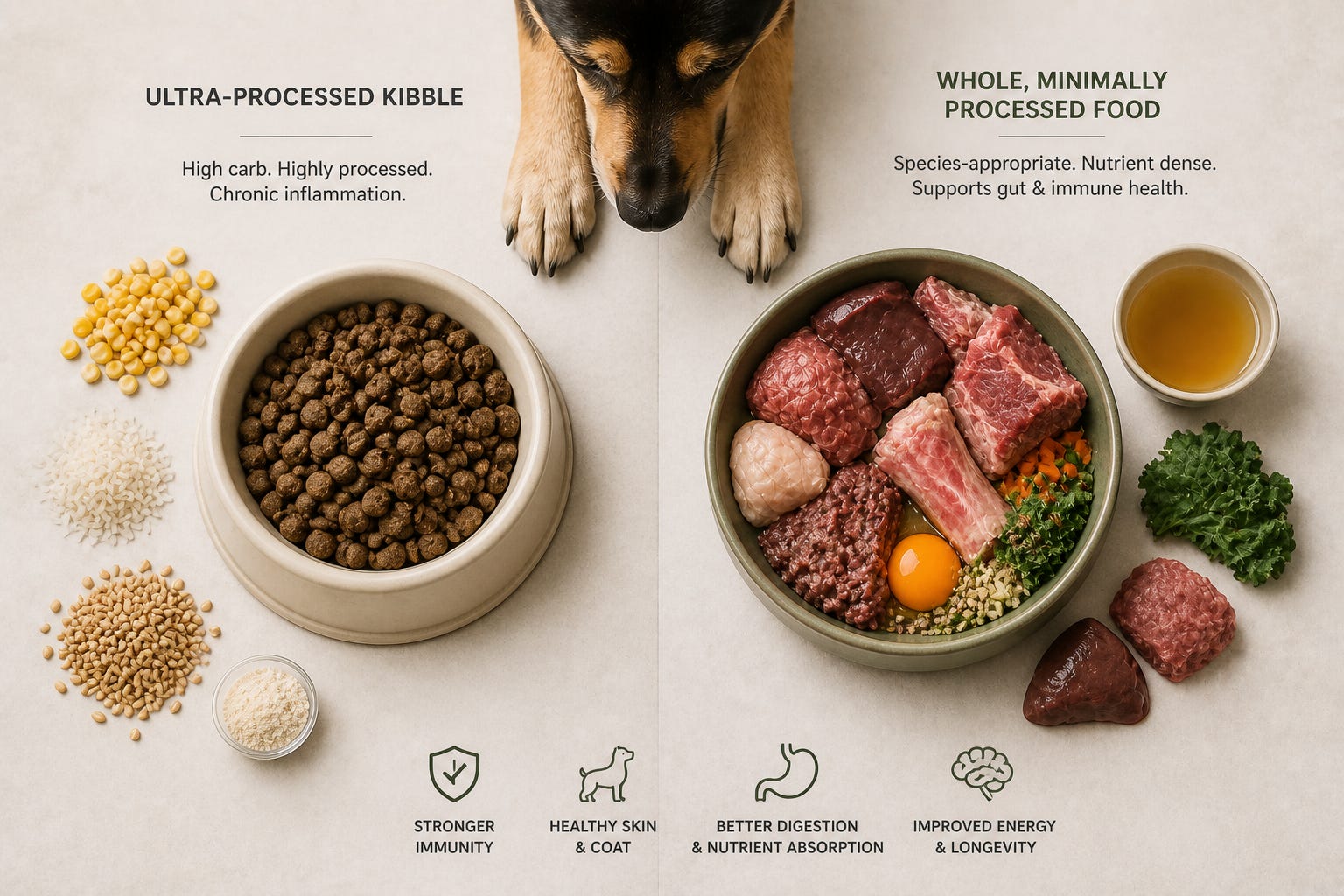
Kibble is not that. Kibble is extruded, meaning ingredients are ground, mixed, heated to 200 to 300 degrees Fahrenheit under pressure, forced through dies, and dried. The starches that hold the pellet together — corn, rice, wheat, potato — typically make up 40 to 60 percent of the bag by volume. Synthetic vitamin and mineral packs are sprayed on after the heat damages the original ingredients. The result is shelf-stable convenience that bears almost no resemblance to what the dog’s body was built to receive.
Dr. Anna Hielm-Björkman and the DogRisk research group at the University of Helsinki have published epidemiological data showing that dogs eating raw or minimally processed food have significantly lower rates of atopic disease compared to dogs eating ultra-processed kibble. Their work is among the strongest evidence available that food drives outcomes, particularly in the tissues most exposed to chronic inflammatory signaling.
Dr. Richard Patton, animal nutritionist and author of Ruined by Excess, Perfected by Lack, makes the metabolic case directly: chronic dietary carbohydrate drives chronic insulin signaling, which drives chronic low-grade inflammation, which shows up in the tissues most exposed to the inflammatory cascade. The skin. The ears. The gut. The bag does not list “carbohydrates” anywhere. That math has to be derived from protein, fat, moisture, and ash. But for most ultra-processed pet foods, the carbohydrate share lands somewhere between 35 and 60 percent of dry matter. That is what the gut is processing twice a day, every day, for years.
What pharmaceuticals do to the gut
Food is one front. Pharmaceuticals are the other.
Most chronic medications used in conventional veterinary practice impact the gut directly, and most pet parents are never told. Antibiotics like doxycycline kill bacteria indiscriminately — the beneficial populations along with the targeted ones — and a single course can shift the microbiome for months. Acid blockers like omeprazole alter stomach pH and disrupt the first line of microbial defense. Corticosteroids like prednisone suppress immune function and thin the intestinal lining. Immunosuppressants like cyclosporine, often prescribed long-term for allergies, chronically dampen the GALT itself.
Each of those medications has a legitimate clinical role. None of that is the argument here. The argument is that when a dog is on one of them — let alone three or four simultaneously — the gut is being acted on continuously, and the body needs active support to compensate. The conventional appointment that prescribes the medication rarely includes a conversation about what to do for the gut while the medication is doing its work.
This is why the dogs who arrive in crisis often have a longer story underneath. The food sensitivities were managed for years on immunosuppressants. The skin issues were controlled on chronic steroids. The recurring infections were treated with course after course of antibiotics. Each intervention solved the immediate symptom. None of them addressed what was happening in the gut. The system held until it didn’t.
What the gut does for the rest of the body
When the gut is healthy, the GALT does its job. Immune cells are properly trained. Inflammatory signaling stays calibrated. The microbiome (trillions of bacteria, yeasts, and other organisms living in the intestine) maintains the diversity it needs to outcompete opportunistic pathogens and keep yeast like Malassezia in check.
When the gut is inflamed, dysregulated, or stripped by repeated antibiotics, every other system pays the price. The microbial diversity collapses. The intestinal lining becomes more permeable, allowing partially digested food particles into the bloodstream where they are read as foreign and trigger systemic immune responses. The immune cells trained in a damaged GALT do not regulate properly. They overreact to harmless inputs and underreact to threats that matter.
This is the mechanism behind the chronic conditions that define modern pet medicine. Atopy. Recurring otitis. Inflammatory bowel disease. Yeast overgrowth on the skin. Chronic ear infections that never quite resolve. Compulsive behaviors driven by gut-brain axis dysregulation. Cancer surveillance that fails because the immune cells doing the surveillance were trained in a compromised system.
Dr. Karen Becker, board-certified integrative veterinarian and co-author of The Forever Dog with Rodney Habib, has spent her career making this case to pet parents. The gut is not a side issue. It is the foundation. Suppressing the symptoms with daily medication while the gut continues to break down is not healing. It is silencing the alarm while the fire spreads.
What we are actually up against
Cancer is now the leading cause of death in dogs over two years old. The Morris Animal Foundation puts the lifetime cancer rate in dogs at roughly one in two. For Golden Retrievers, the lifetime risk lands between 60 and 65 percent. That is not a future generation’s problem. That is the dog asleep on the couch right now.
Cancer is, at the cellular level, an immune surveillance failure. The body is constantly producing abnormal cells. A functioning immune system identifies and clears them before they replicate into a tumor. When the immune system is suppressed, dysregulated, or trained in a damaged GALT, that surveillance fails. The abnormal cells are no longer caught. They become the diagnosis nobody wanted.
This is the consequence the rest of this article has been building toward. Every choice that protects the gut protects immune surveillance. Every choice that compromises the gut compromises it. The food in the bowl, the medications in the cabinet, the chemicals on the lawn, the water in the dish. None of it is neutral. All of it is either feeding the system or burdening it.
The dogs who live to fifteen and sixteen in vibrant health are not accidents. They are the result of pet parents who understood this earlier rather than later, and acted on it.
If the cancer conversation is the one that matters most to you right now, the most comprehensive resource available is The Dog Cancer Series by Rodney Habib and Dr. Karen Becker. Six hours of interviews with fifty oncologists, cancer researchers, and integrative veterinarians, including Dr. Thomas Seyfried on the metabolic theory of cancer, Dr. Richard Patton on nutrition, and Dr. Anna Hielm-Björkman on the food research. It is the deep dive every pet parent facing this conversation should have access to.
What you can do this week
The protocol that addresses the gut is not exotic. The single highest-leverage interventions for most dogs are also the simplest.
Add real bone broth to the bowl. Human-grade, no onion, no leeks. Kettle & Fire and Brutus Broth are both clean and widely available at most grocery stores. The collagen and gelatin are the literal building blocks of mucosal tissue. The glycine is directly hepatoprotective. Pour a few tablespoons warm over whatever they are eating right now.
Add plain whole-milk kefir as an evening ritual. A few tablespoons, every day, with a small handful of frozen blueberries on top. Lifeway and 365 are both clean and available at most grocery stores. Living cultures in a food matrix the body recognizes, including beneficial yeasts that no probiotic capsule can replicate. The kefir is not optional. It is doing immune work, not just digestive work.
Replace the plastic bowls with stainless steel or ceramic. Switch to filtered water. Both are one-time decisions that remove daily exposure to compounds the body has to clear.
And then begin the harder conversation about what is in the bowl. Not all at once. Not perfectly. But honestly. Because the dog in front of you was built for real food, and most of what is happening with their skin, their ears, their behavior, and their immune resilience starts there.
The North Star
“Wellness is not just the absence of disease. It is actually recognizing that we can make intentional lifestyle choices on a daily basis that ultimately create abundant health.”
— Dr. Karen Becker
That is the foundation of everything I do at Integrative Pet Parent and the lens I bring to every Second Opinion. Wellness is not a single decision. It is a daily practice. Food, movement, supplements, stress, environment. My job is to help you choose with clarity and confidence.
If your dog is the one in this article
The pattern this article describes is not rare. It is the picture I see across most of the dogs I coach: different breeds, different ages, different presenting complaints, the same underlying mechanism. If you read this and recognized your own animal somewhere in it, you are not imagining it. You have been seeing what is actually there.
A Second Opinion is what I built for exactly this moment. You bring the bloodwork, the medications, the food they are currently eating, and the patterns you have been noticing. I bring the integrative lens. Pattern recognition across years of records, root-cause investigation, and a complete plan you can actually follow. The first 100 founding members receive a complimentary session valued at $350.
I am in your corner.
Further Reading
The voices and research that inform this work, with links for pet parents who want to verify and go deeper.
Dr. Karen Becker, DVM. Board-certified integrative veterinarian and co-author of The Forever Dog with Rodney Habib. drkarenbecker.com
Dr. Anna Hielm-Björkman, DVM, PhD. Lead researcher of the DogRisk research group at the University of Helsinki, publishing extensively on the health differences between dogs eating raw or minimally processed food versus ultra-processed kibble. dogriskhelsinki.fi
Dr. Richard Patton, PhD. Animal nutritionist whose work on the metabolic and inflammatory consequences of carbohydrate-heavy pet food is foundational to integrative nutrition thinking. Ruined by Excess, Perfected by Lack (Dogwise Publishing, 2011).
Dr. Jean Dodds, DVM. Founder of Hemopet, foremost authority on canine immunology, vaccine response, and thyroid disease. hemopet.org
Morris Animal Foundation Golden Retriever Lifetime Study. The largest prospective canine health study ever undertaken, tracking thousands of Golden Retrievers across their lifespans to identify the genetic, nutritional, and environmental drivers of cancer and chronic disease. morrisanimalfoundation.org
The Dog Cancer Series. A seven-chapter documentary by Rodney Habib and Dr. Karen Becker, six hours of interviews with fifty oncologists, cancer researchers, and integrative veterinarians. Featured experts include Dr. Thomas Seyfried (metabolic theory of cancer, Boston College), Dr. Greg Ogilvie (veterinary oncology, UC Davis Moores Cancer Center), Dr. Alice Villalobos (UC Davis, author of the canine quality-of-life scale), Dr. Erin Bannink (board-certified veterinary oncologist with integrative training), Daniel Orrego (KetoPet Sanctuary), Dr. Richard Patton, Dr. Anna Hielm-Björkman, and Dr. Jean Dodds. The most comprehensive single resource available on canine cancer prevention and treatment. dogcancerseries.com
FDA Alert on Isoxazoline-Class Parasiticides (September 2018). Formal FDA notice regarding neurological adverse events including muscle tremors, ataxia, and seizures associated with NexGard, Bravecto, Simparica, and Credelio. fda.gov isoxazoline alert
American Holistic Veterinary Medical Association. Professional directory of board-certified integrative veterinarians by region, for pet parents seeking integrative care. ahvma.org
The Forever Dog Life. Becker and Habib’s continuing platform on canine longevity research and applied integrative care. foreverdoglife.com
— Jenn │ Integrative Pet Parent