

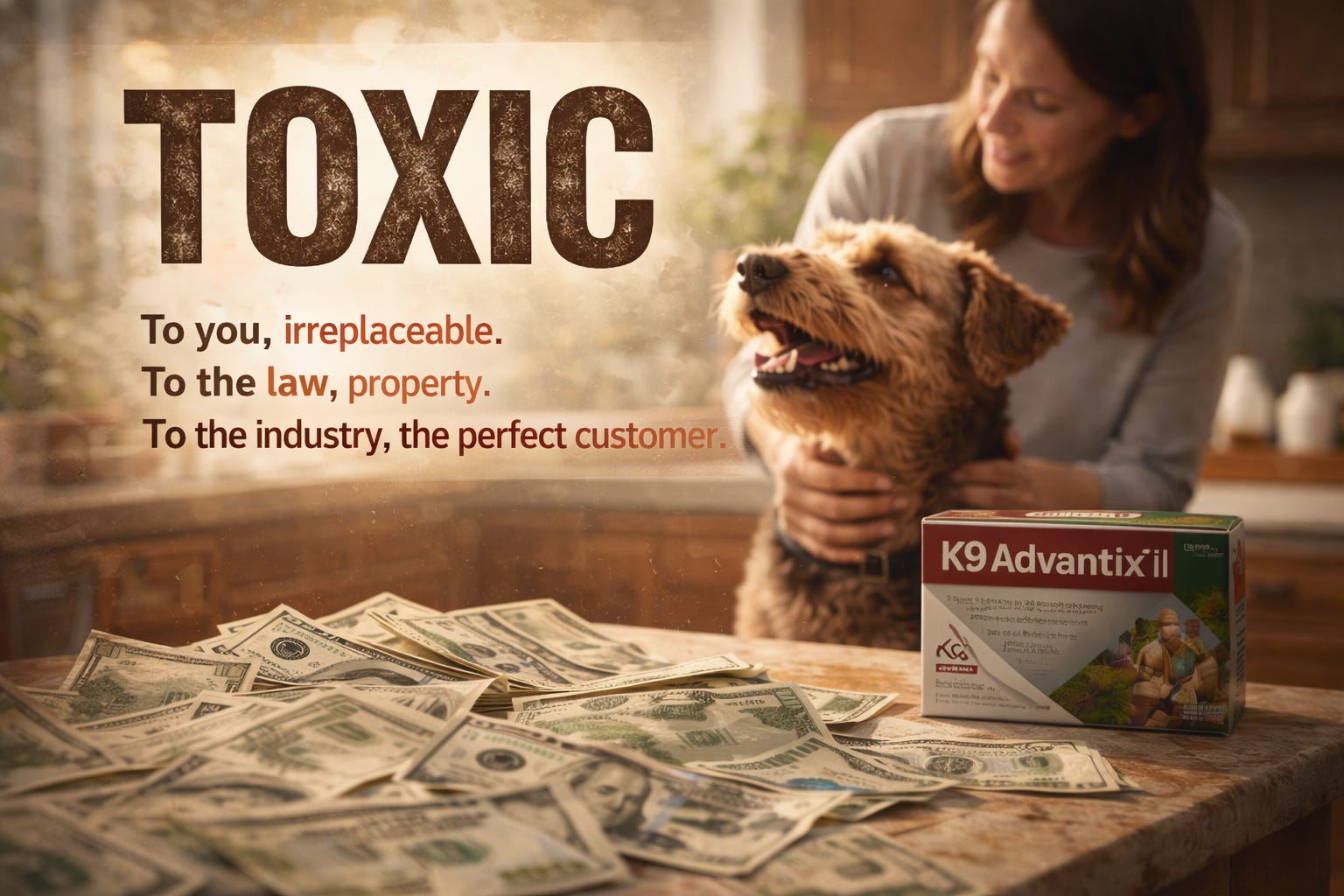
My friend sent me a text with a photo attached.
It was a box sitting on her mother’s kitchen counter. K9 Advantix II. Her mom has an Airedale Terrier. She’d picked it up at Costco. Lower cost, easy to grab with the groceries, exactly what she’d been told to use. And like tens of millions of pet parents across this country, she has been doing what she thought was right. Monthly flea and tick prevention. On schedule. Never misses a dose.
The text read: Is this bad?
I stared at the photo for a long minute.
Yes. But the fuller answer is much worse. Because this isn’t a story about one product. It’s a story about an industry worth nearly $10 billion that has spent decades making sure you don’t ask questions. It’s about who profits from your trust, who shapes what your vet recommends, and what they’ve all agreed not to tell you.
The Machine
Let’s start with the numbers, because the numbers tell you everything.
The global flea and tick prevention market was valued at $7.8 billion in 2024. It’s projected to reach $14.1 billion by 2034. That’s not a wellness industry. That’s a chemical dependency model. Engineered to keep your dog on a monthly dosing schedule, every month, every year, for the life of your pet.
American pet owners spend between $200 and $400 per pet annually on preventive parasite treatments alone. Multiply that across the 68 million U.S. households that own dogs. The math gets uncomfortable fast.
And here's who's collecting: Elanco. Zoetis. Merck Animal Health. Boehringer Ingelheim. Hartz Mountain. Ceva. The same conglomerates that dominate human pharmaceuticals — and the mass-market brands on the shelf at your big box store — found a second revenue stream in your pets, with far less regulatory friction and almost none of the public accountability that human medicine requires.
“Animal health is a much steadier business than the human-pharmaceuticals business. Animal products tend to have very nice margins, there’s much lower threat of generic competition, and there’s a lot of brand loyalty.” — Industry analyst, Bloomberg
Brand loyalty. That’s what they call it when a pet parent trusts their vet and never asks what’s actually in the box.
When a product designed to apply pesticides directly to your dog’s skin is sold at Costco next to bulk olive oil and paper towels, accessibility becomes its own form of endorsement. Nobody questions what’s in the rotisserie chicken either.
Just because something is widely available, deeply discounted, and sitting in a warehouse next to things you trust does not mean it is good for you. Or for the animal sleeping on your sofa.
How Your Vet Got Recruited
In human medicine, pharmaceutical influence on physicians got so bad that Congress had to legislate against it. The Physician Payments Sunshine Act now requires drug companies to publicly disclose payments to doctors: consulting fees, speaking arrangements, sponsored travel, funded research. The law exists because the corruption was documented and undeniable.
And even with mandatory disclosure, the influence persists. Paid speakers at medical conferences. Company-funded studies that shape prescribing guidelines. Research conclusions that follow the money. The ethical line exists on paper. In practice, it has been negotiated into something much more convenient.
In veterinary medicine? There is no Sunshine Act. No disclosure requirement exists at all.
Your doctor cannot legally profit from the drugs they prescribe you. They write the script; you fill it at a pharmacy. That separation exists to limit the financial conflict, imperfectly, but it exists.
Your veterinarian can — and routinely does — both prescribe and sell medication directly out of their office, often marked up 100 percent.
Meanwhile, pharmaceutical companies sponsor veterinary conferences, fund continuing education, and feature their products prominently in every handout and presentation. Drug companies have spent two decades reshaping veterinary school curricula, conditioning practitioners and pet owners alike to believe that synthetic chemicals administered monthly are simply what responsible pet ownership looks like.
Your vet isn’t corrupt. Most of them genuinely believe what they were taught. That’s exactly how a captured system works — you don’t need to bribe everyone. You just have to own the curriculum.
Now Follow the Money
K9 Advantix II was built by Bayer. In 2020, Bayer completed the sale of its entire animal health division to Elanco Animal Health for $6.89 billion. New name on the box. Same formula. Same liability. Conveniently transferred.
Before that sale, Bayer had another problem on its hands.
In 2018, Bayer acquired Monsanto for $63 billion. With that acquisition came Roundup. The World Health Organization’s International Agency for Research on Cancer classified glyphosate, Roundup’s active ingredient, as “probably carcinogenic to humans” in 2015. That classification opened the floodgates.
Approximately 170,000 Roundup lawsuits have been filed against Bayer and Monsanto. Bayer has paid out nearly $11 billion in settlements. In April 2025 alone, a jury ordered Bayer to pay over $2 billion to a Georgia man who developed non-Hodgkin’s lymphoma after using Roundup at home for 20 years.
Bayer’s position throughout all of it? The product is safe.
One company. Roundup. K9 Advantix II. Nearly $11 billion in cancer settlements. And a consistent message: trust us.
This is the company that developed what went into that cabinet. The company that submitted its own safety data to the EPA to get its own products approved. A standard industry practice that should alarm every one of us. The company that walked away with nearly $7 billion when they sold the animal health portfolio, handed the brand to Elanco, and kept moving.
The product didn’t change. The accountability just got harder to trace.
The Dirty Secret About Risk
Now private equity has entered the room. And this is where the math becomes truly sinister.
Private equity has poured over $51 billion into the veterinary sector, with another $9.3 billion invested in just the first four months of 2024 alone. Over 30 percent of general veterinary practices are now under corporate ownership, up from just 8 percent a decade ago. In specialty and emergency care, that number exceeds 75 percent.
Why? Because veterinary medicine is, in the words of one investment firm, “safe relative to human medicine.” Consistent returns. Emotionally driven consumers. And critically: almost no liability ceiling.
Here is the piece of this story that nobody in the industry wants you to understand.
Under U.S. law, your pet is property.
Not a family member. Not a dependent. Property. With a market value courts will determine based on breed, age, and purchase price. For a rescue dog, which most beloved family pets are, that legal value is often nominal. Even in the most generous jurisdictions, non-economic damages for the loss of a pet are capped in the thousands of dollars. Maryland caps pet injury damages at $10,000. Tennessee allows up to $5,000 for loss of companionship. Most states allow nothing beyond fair market value and vet bills.
Let that sit for a moment.
A pharmaceutical company sells a product that causes seizures in 20.5 percent of reported adverse events. Dogs die. Families are devastated. And the maximum legal exposure for that company — per animal — is a fraction of what a single monthly dose costs at the vet.
The risk calculus isn’t broken. It’s working exactly as designed. When the liability ceiling for harming your dog is lower than your monthly cable bill, there is no financial incentive to pull the product.
This is why the FDA issued an alert on isoxazolines and then did nothing. This is why 66.6 percent adverse event rates don’t trigger recalls. This is why the machine keeps moving regardless of what the data shows.
Private equity didn’t create this loophole. They just recognized it as an investment thesis.
Your grief is real. Your love is real. Your legal standing is worth almost nothing — and the industry has known that since the beginning.
What’s Actually in the Box
K9 Advantix II contains three active ingredients.
Imidacloprid — a neonicotinoid insecticide. A 2022 study published in Environment International found associations between imidacloprid exposure and liver cancer in humans, with odds ratios ranging from 2.33 to 9.02. In mammalian research, which applies across warm-blooded animals including your dog, it causes liver and kidney toxicity and, at higher doses, specifically suppresses T-cell immune response. For any dog already managing chronic illness, that’s not a footnote. That’s an accelerant.
Permethrin — at 44 percent of the formula by weight. The U.S. EPA classifies it as “likely to be carcinogenic to humans” if ingested. Peer-reviewed research links pyrethroids to DNA damage in the specific genes associated with leukemia and lymphoma. This compound is absorbed through your dog’s skin and transferred to every person who touches them, including your children.
Pyriproxyfen — a hormone-mimicking compound that prevents flea egg development. The long-term mammalian studies are thin. Which, when you think about it, is its own kind of answer.
This is applied to your dog’s skin. Once a month. Every month. Year after year. And your dog can’t ask questions.
Simparica Is Not the Answer
The most common thing I hear when I raise concerns about K9 Advantix II: My vet switched us to Simparica. That’s better, right?
It’s not better. It’s a different category of harm.
I’ve sat with pet parents whose previously healthy dogs started seizing after the first dose. No history of neurological issues. No warning beyond the fine print nobody reads. That’s not a rare edge case. The data says so.
Simparica belongs to a drug class called isoxazolines. The FDA has formally alerted pet owners and veterinarians that isoxazoline products have been associated with neurologic adverse reactions, including muscle tremors, ataxia, and seizures. Seizures may occur in animals with no prior history of neurological issues.
Zoetis, the company that makes Simparica, states it on their own label: seizures have been reported in dogs receiving isoxazoline class drugs, even in dogs without a history of seizures. They tell you. In the fine print most people never read.
The Project Jake study, a large-scale independent survey of nearly 2,800 veterinarians and pet owners co-authored by Dr. Jean Dodds and published in peer-reviewed Veterinary Medicine and Science, found that of 1,594 dogs given a flea treatment, 66.6 percent experienced an adverse event. For sarolaner, the active ingredient in Simparica, FDA adverse event reports showed 3.2 percent deaths and 20.5 percent seizures among reported events.
Two out of ten dogs. Seizures.
And vets keep prescribing it. Because the machine keeps moving. And because when your dog seizes and dies, the lawsuit is worth almost nothing.
Start Here
This is the part the industry doesn’t want to be simple. But it is.
The most powerful thing you can do for your dog has nothing to do with a monthly chemical. It starts with food.
A species-appropriate diet: real, whole food your dog’s body was designed to process. It builds the kind of immune resilience that makes your pet a less desirable host for parasites in the first place. The goal isn’t just to kill fleas and ticks after they arrive. The goal is to create an internal environment they don’t want to be part of. Parasites are opportunists. They go where the terrain is easy. Change the terrain.
Not sure where to start with food? When evaluating any raw food provider, look for two things: full transparency on protein sourcing, and rigorous food safety certifications that don’t rely on over-processing. HPP processing is one approach some companies use. Others take a different path — truly raw, no HPP, no high-heat processing, with USDA-approved proteins and 100% end-to-end traceability built into their operation.
Carnos is one provider worth knowing. A family-owned company based in Hyattsville, Maryland, founded by seven generations of Dutch butchers who know meat. They ship nationally and offer local pickup in the DC Metro area. First-time orders over $100 get 15% off site-wide — use code FRIENDS&FAMILY at checkout, or order through this referral link.
That’s the philosophy I run my own dog’s protocol around. Here’s what else it looks like in my house.
Fresh garlic. I add it to Bella’s food. The sulfur compounds in garlic seep through the skin and make dogs measurably less attractive to ticks and fleas. A study of Swedish Marines confirmed this exact mechanism in humans. Dr. Karen Becker, one of the most respected integrative veterinarians practicing today, has written extensively about garlic’s genuine benefits for dogs and the mythology around its toxicity, which stems almost entirely from studies using extreme doses no pet parent would ever realistically feed. The research-backed weight-based dosing:
10–20 lbs: ½ clove per day
20–40 lbs: 1 clove per day
45–70 lbs: 1½ cloves per day
75–90 lbs: 2 cloves per day
90 lbs and over: 2½ cloves per day
Always fresh. Always chopped or crushed first to activate the allicin before adding to food.
A note on garlic powder: don’t substitute it. The dehydration process concentrates the compounds that become problematic at higher doses, and the dosing equivalency doesn’t hold. You’d be getting more of the risk and less of the benefit. Fresh only, always.
Japanese and Korean breeds like Shiba Inus and Jindos have a higher sensitivity to thiosulfate. Keep them at the lower end of the range. And as always: discuss with an integrative vet before starting, especially if your dog has any existing health conditions.
Curcumin. A well-documented anti-inflammatory with antimicrobial properties. Goes into Bella’s food daily. It supports immune function systemically, the kind of baseline resilience that makes a dog less hospitable to parasites and less vulnerable to the cumulative toxic load of living in a chemical-forward world.
Apple cider vinegar. A small amount in the water bowl. Alters the body’s pH slightly, making the skin environment less inviting to external parasites.
The best flea and tick prevention isn’t a product. It’s a thriving immune system that makes your dog an inhospitable host.
For the external layer, because yes, you still need real-world protection:
Wondercide Flea, Tick & Mosquito Spray (cedarwood and rosemary-based): effective, family-safe, no neurotoxicity concerns. First recommendation for every client.
Cedarcide: another cedar-based option, excellent for yard and environmental treatment alongside a topical.
Tick checks after every outdoor exposure: non-negotiable, costs nothing, catches what the chemicals are supposed to prevent.
The conversation your vet may not start. Ask directly: What is this dog’s actual flea and tick burden? Does that justify a monthly systemic chemical year-round, or is there a seasonal, targeted approach that gives real protection with less cumulative load on the liver, immune system, and nervous system?
Ask it. Make them answer it. You are allowed to ask.
If you want help building a protocol that looks at your dog’s full picture: diet, immune support, and right-sized protection, that’s exactly what integrative pet health coaching is for.
Schedule your complimentary session here →
Now Do Something With This
Reading this and moving on is exactly what the industry is counting on.
Here’s what you can actually do. Start today, and go beyond your dog’s bowl.
Know who owns your vet. Over 30 percent of general practices and 75 percent of specialty clinics are now PE-owned. That changes who your vet answers to. Search your practice at privateequityvet.org, a database built specifically so pet owners can find out.
Ask your vet directly about pharmaceutical relationships. You are allowed. Ask whether they receive compensation: speaking fees, sponsored travel, research funding from the companies whose products they prescribe. Watch what happens. The answer, or the discomfort with the question, tells you something important.
Know your state’s pet property law. Several states are actively working to reform how courts value companion animals. Tennessee and Illinois have made meaningful progress. If your state hasn’t, that’s a legislative gap a single constituent letter can help close. Find your state legislators at usa.gov/elected-officials and tell them you want reform. Pet property law is winnable at the state level. It doesn’t require an act of Congress.
Push for a Veterinary Sunshine Act. There is no federal requirement for pharmaceutical companies to disclose payments to veterinarians. There should be. Contact your U.S. Representative and Senators and ask them to support veterinary payment disclosure legislation. If enough pet parents ask, someone will introduce it.
Share this article. The industry depends on you not knowing, not asking, and not talking. Every person who reads this is one less perfect customer.
Your dog trusts you completely.
That’s not a burden. That’s the whole point.
All Integrative Pet Parent content is free. If this changed how you see what’s in your dog’s cabinet, send it to someone whose pet needs them to read it.
The information in this article is for educational purposes and does not constitute veterinary medical advice. Always consult a qualified veterinarian, ideally an integrative one, before making changes to your pet’s health protocol.