

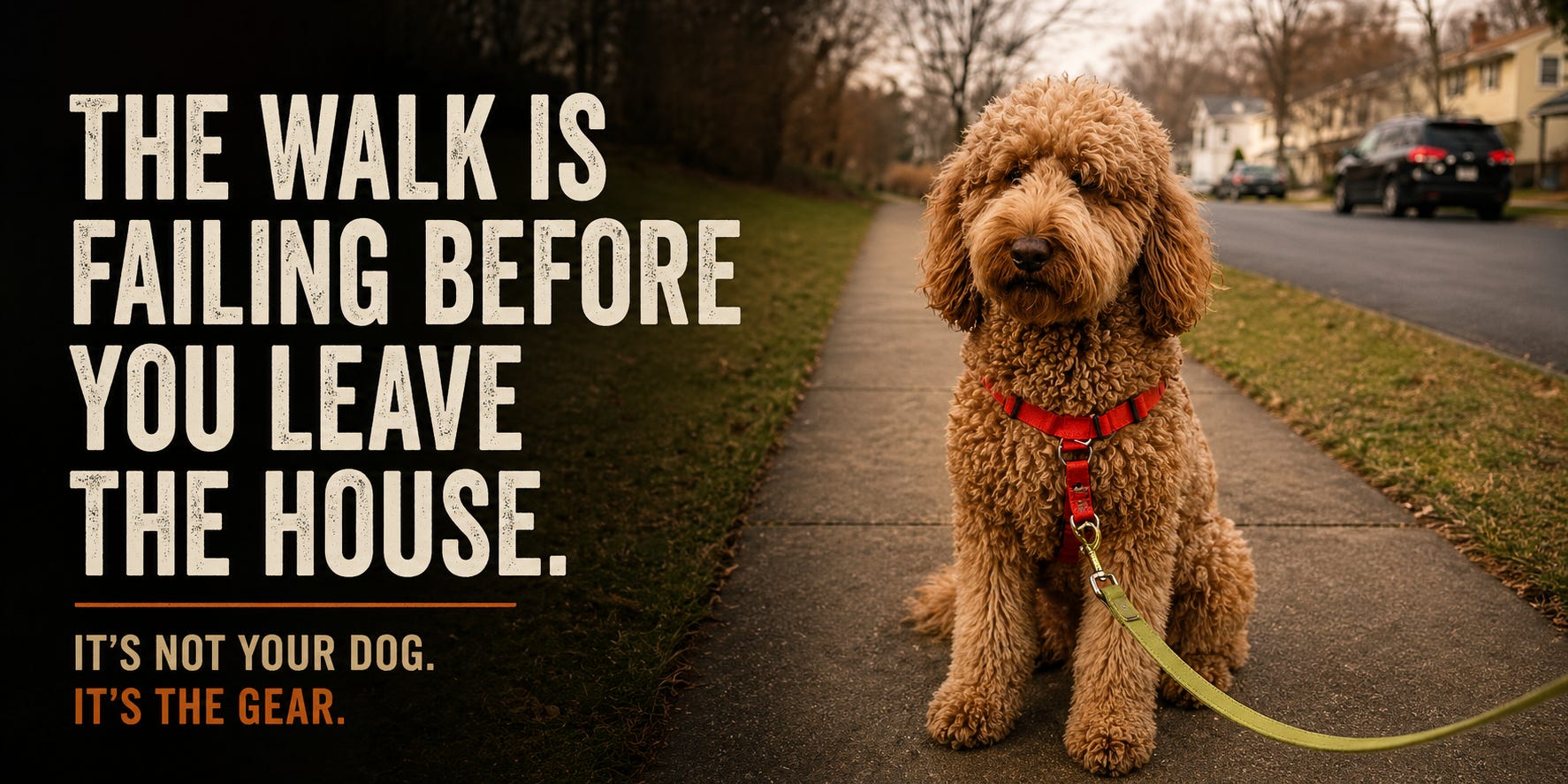
Years in the pet care industry teach you something pet stores will never tell you.
My team and I walked thousands of dogs across every breed and build the city of Washington, DC could throw at us. Big dogs. Small dogs. Pullers. Reactive dogs. Dogs in training. Dogs whose owners had given up on training. On average, we took over fifty thousand photos a year of those dogs on walks, on adventures, in our care. That is the volume I am drawing from.
In all those years, the single most common reason a walk went badly was not the dog.
It was the equipment on the dog.
The harness in your hallway. The leash hanging by the door. Most of the gear pet parents are using right now is quietly making their walks worse, their dogs more frustrated, and in some cases, doing real damage to bodies that cannot tell anyone what hurts.
This is the breakdown I want every dog parent armed with.
You Are Strapping a Strongman Vest to Your Dog
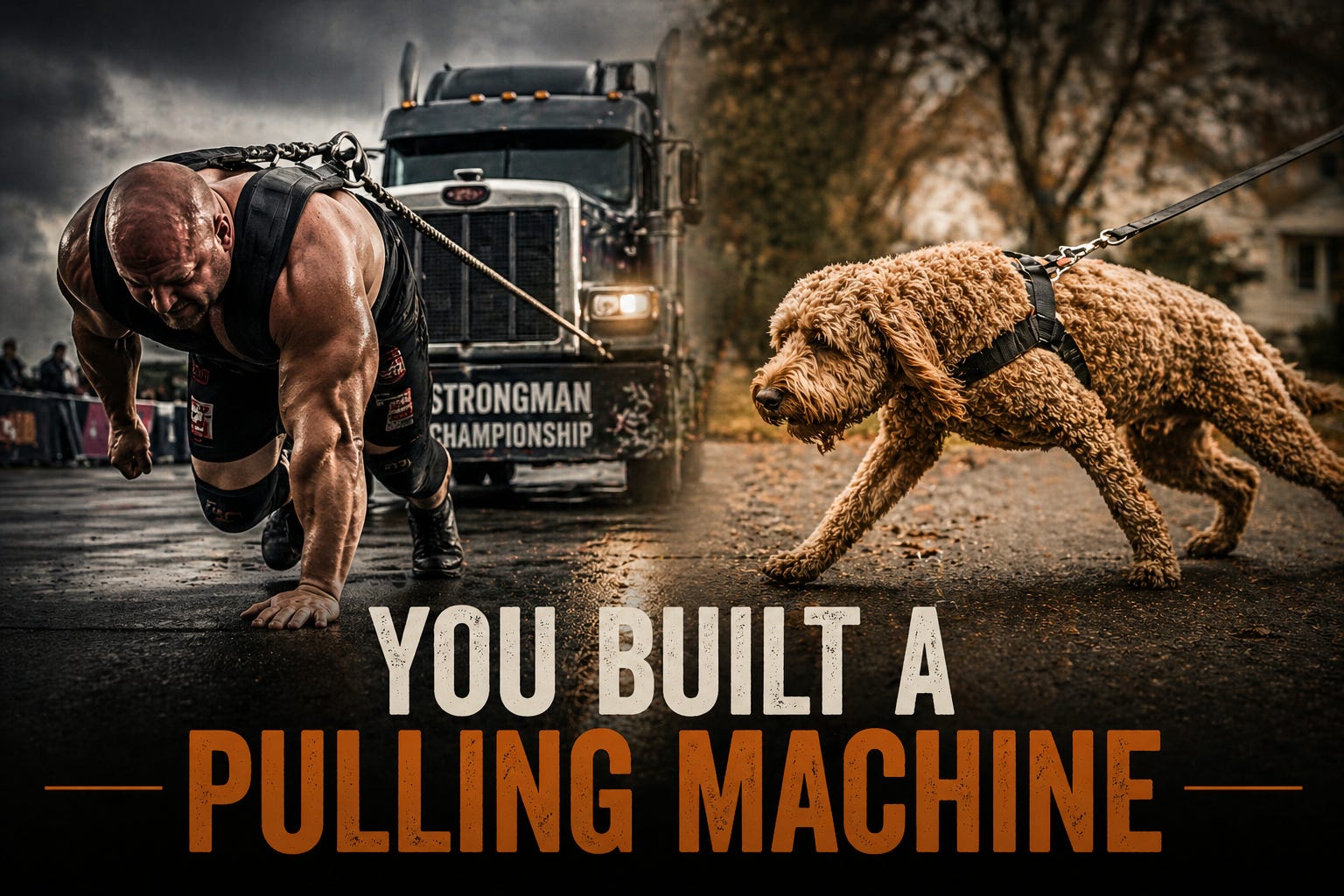
Picture the World’s Strongest Man competition. The vest. The thick chest strap. The big metal clip on the back where the chain hooks in. Then the man leans forward and pulls a semi-truck across a parking lot.
That clip on the back is not decorative. Engineers chose that exact placement because it is the most biomechanically efficient way for a body to pull something massive forward.
Now look at the harness on your dog.
Clip on the back? You just put your dog in a strongman vest. You are telling your dog, in the clearest possible language a body can understand, pull harder. The harness is doing the same job for your fifty-pound retriever that it does for a four-hundred-pound athlete dragging a truck.
Then you wonder why your dog pulls.
Your dog is not being defiant. Your dog is responding correctly to the equipment you put on them. The equipment is the problem.
What the Wrong Equipment Actually Does to Your Dog
This is the part most people do not want to read. Read it anyway.
When a dog pulls against a flat collar, the entire force of that pull lands on the trachea. The windpipe. A soft, cartilage-ringed tube that was not designed to absorb that kind of repeated, focused pressure. Veterinary research has documented that leash pulling against a collar increases the risk of permanent tracheal, laryngeal, esophageal, and ophthalmic damage in dogs. That is the published medical literature, not opinion.
Tracheal collapse. Honking cough. Difficulty breathing. Symptoms that worsen with excitement. Once it starts, it does not get better. It gets managed.
Small breeds and toy breeds are most at risk. Yorkies. Pomeranians. Chihuahuas. Their tracheas are already delicate. A flat collar with a leash pull on a small dog is a direct line to the surgery table.
Brachycephalic breeds. Pugs. Bulldogs. French Bulldogs. They are already fighting for air with the structure they were born with. Adding neck pressure to that equation is cruelty dressed up as a walk.
A chiropractic study out of Sweden examined 400 dogs and found that 252 of them had spinal misalignments. Sixty-five percent of the dogs with spinal problems also had behavioral problems. Read that again. The behavior issue most owners are trying to fix may be downstream of the equipment they are using.
A long-running German study followed 100 dogs walked on either choke collars or properly used prong collars across their entire lives. On autopsy, 48 of the 50 choke collar dogs had injuries to the neck, trachea, or back. The prong collar dogs, when fitted and used correctly, did not show the same pattern.
This is what is happening on the inside of the dog you love while you walk them. The dog cannot tell you. The damage compounds.
What About Collars?
Two different conversations get confused here. Let me separate them.
The walking attachment. This is what the leash clips to. For most dogs, this should be a properly fitted harness, not a collar. If a collar is being used as the walking attachment, the trachea damage I described above is the risk you are running every single walk.
The everyday collar. What your dog wears around the house with their ID tags.
My dogs do not wear collars in the house. Period.
You never know what is going to happen. A collar can catch on the slats of a kennel. On a heating vent. On another dog’s jaw during a play session that goes too rough. On a piece of furniture during the zoomies. Dogs have strangled to death in their own homes on the collars their owners thought were keeping them safe.
If your dog is going to wear a collar in the house, make it a quick-release collar. The kind with a buckle that snaps open under pressure. That one design choice is the difference between a near-miss and a tragedy.
Microchip your dog. Update the registration. That is the real ID system. The collar tag is a backup, not the primary tool.
A note on martingale collars. A martingale is a specific tool, designed for sighthounds, whippets, greyhounds, salukis, dogs whose heads are smaller than their necks and slip out of standard collars. When fitted correctly, a martingale tightens just enough to prevent escape, not enough to choke. That is its only legitimate use case.
A martingale is not a walking solution for the average dog. It still puts pressure on the neck when the dog pulls. The pressure is more evenly distributed than a flat collar, but it is still neck pressure, and the trachea is still in the line of force. Use the harness.
What a Harness Should Actually Do
A good harness does three things at once.
It keeps your dog secure. No slipping out, no escape risk, no broken clips when something startles them.
It does not encourage pulling. The clip placement matters. The fit matters. The structure matters.
It protects the body. No pressure on the trachea. No chafing under the legs. No riding up into the armpits. No sliding around so the load lands wrong on the shoulders.
That is the whole list. Padding does not matter. Color does not matter. The cute pattern your sister-in-law sent you for the holidays does not matter.
If a harness fails on any of those three, it is the wrong tool. It does not matter how many five-star reviews it has.
The One Harness I Reach For
The Freedom Harness by 2 Hounds Design.
This is the harness I have used on more dogs than I can count. Across breeds, builds, temperaments, training levels. It is the one I trust.
It is also the harness we required for any dog joining our pack adventures. Not requested. Required. We did not put a dog in our vehicle, on our trail, or in our group walks without one. That is how much we believed in it.
Here is why.
It has a front clip and a back clip. The front clip is the one that matters. When a dog pulls forward against a front clip, the harness gently redirects them sideways, back toward you. It does not reward the pull. It interrupts it. Over time, the dog learns that pulling does not get them where they want to go, and the walks get easier on their own.
It is lined to prevent chafing. The strap that sits behind the front legs is the most common failure point on cheap harnesses. The Freedom Harness is built to sit there without rubbing the skin raw.
It clips into a seat belt restraint cleanly. If you travel with your dog, this matters more than people realize. A harness that doubles as a vehicle restraint is a harness that earns its keep twice.
Sizing note: when you order, measure your dog. If you fall between sizes, choose the wider strap. The Freedom Harness comes in a 1-inch and a 5/8-inch width. Choose the 1-inch. Wider straps distribute pressure better and last longer.
If your dog is under fifteen pounds, or extremely low to the ground (a basset hound, a dachshund, an English bulldog), the Freedom Harness may not be the right fit for the build. Reach out and I will point you to a better option for your specific dog.
When a Harness Is Not Enough
Some dogs pull no matter what harness you put on them. Big, strong, driven dogs. Dogs with high prey drive. Dogs whose training is still being built.
For those dogs, I reach for the Herm Sprenger Curogan prong collar.
I know how that sounds to people who have only seen prong collars in horror stories. Hear me out.
A properly designed and properly used Herm Sprenger does not pinch. It cannot pinch. The prongs sit in two opposing directions with a center plate between them, which means when the collar tightens, the links pull symmetrically. Even pressure distributed in a band around the neck, about every half inch. No tugging, no jerking, no pressure on the trachea.
Placement is critical. A Herm Sprenger does not sit on the lower neck where a regular collar lives. It is designed to be positioned high up on the neck, snug just behind the ears, where a dog naturally communicates with another dog. Low on the neck is where the trachea is. High behind the ears is where the dog actually feels guidance, the way a mother dog corrects a puppy. If your prong collar is sliding down to sit like a flat collar, it is in the wrong position and it is not working as designed.
The Curogan version specifically is made of a copper-tin alloy. Completely nickel-free. Hypoallergenic. This is the one I would put on my own dog.
Two non-negotiables.
You must use it correctly. Sized to fit snug, positioned high on the neck just behind the ears, never sliding down to the lower neck, never yanked. If you do not know how to fit one or use one, get a professional trainer. A balanced trainer will teach you in one session.
You must never buy a knock-off. The two-direction prong design with the center plate is what makes the Herm Sprenger safe. Off-brand prong collars do not have this. They can pinch, they can fail, they can hurt your dog. If it does not say Herm Sprenger on the box, do not put it on your dog. Period.
Used correctly, this is one of the most humane training tools on the market. Used incorrectly, or in a knock-off version, it is exactly what the headlines warn you about.
Just Say No to the Retractable Leash
Retractable leashes were originally designed as a training tool. Specifically for tracking work and long-distance recall. Professional trainers will tell you the same thing: if you do not know what those uses are, you have no business owning one.
Then somewhere along the line a marketing person who had never handled a working dog looked at the design and said we could sell millions of these to people walking around the neighborhood.
And here we are. Dogs that do not know how to walk on a leash. Owners who cannot understand why.
The data on retractable leashes is brutal.
A study published in the American Journal of Emergency Medicine tracked dog-leash-related injuries treated at US emergency departments from 2001 to 2018. The total: an estimated 356,746 injuries. Of those, 193,000 were caused by pulling. Another 136,000 by tripping or tangling. Twenty-six percent of those injuries resulted in fractures.
Veterinary emergency medicine specialists report seeing the same pattern over and over. Cervical disc herniations. Torn larynxes. Tracheal lacerations from the sudden jerk when a sprinting dog hits the end of an extended cord. Eye injuries when the cord snaps and the metal clip whips back into a face. Finger amputations. Rope burns severe enough to leave lifelong scarring.
Beyond the injuries, retractables train your dog to pull. The cord stays under tension. The dog learns that pulling earns more leash. Pulling gets rewarded every single walk, which is the exact opposite of the lesson you are trying to teach.
Dr. Karen Becker, the integrative veterinarian whose work guides much of what I write here, has been blunt about this for years. She does not recommend retractable leashes for casual walking. Period.
If you have a retractable leash hanging by your door, take it down. Put it in the garage with the other tools you bought once and should not use.
The Leash You Should Actually Be Using
A good walking leash is not complicated.
Length: Six feet for everyday walks. Long enough for the dog to move naturally, short enough for you to keep them close when you need to.
Width: At least one inch thick. Thinner leashes are harder on your hands when a dog lunges, and they wear out faster.
Handle: A real, padded handle that fits your hand. If a leash leaves welts on your palm during a normal walk, it is not the right leash.
Clip: A strong, solid metal clip. Not the cheap plastic-coated ones that fatigue and snap at the worst possible moment. The clip is the single point of failure between you and your dog. Buy a good one.
The structure I reach for is a double-connection leash. A double-connection leash has clips at both ends, which lets you attach to the front and back of a properly designed harness simultaneously. That dual-point connection is what gives you real control. Pull from the front to redirect, anchor from the back for stability. It is the same leash structure professional handlers and trainers use.
2 Hounds Design makes two versions of their double-connection leash, both designed to pair with the Freedom Harness:
The Training Leash. Three feet when clipped to both points on the harness, five feet when used single-point. Permanently attached floating handle. This is the one you want for a dog still learning, a strong puller, a new rescue, or any high-traffic situation where you need them close. Shorter leash, more control.
The Euro Leash. Five feet when clipped to both points (including the detachable handle), eight feet single-point. The handle slides freely along the leash and detaches when you want to use it as a traffic handle on its own. This is the one for trained dogs who have earned more freedom, longer walks, varied environments. The detachable handle also lets you go hands-free across the body or anchor to a pole when you need to step away briefly.
Both work with the Freedom Harness. Choose based on where your dog is in their training, not on color or pattern. If you are not sure, start with the Training Leash. The shorter length forces better walking habits, and you can graduate to the Euro Leash once those habits are built.
The leash is part of the system, not an accessory. Buy it together with the harness.
The Harnesses We Used to Use and Why We Stopped
A few honest notes on the other tools you will see recommended online.
The Deluxe Easy Walk Harness. This used to be our pick before the Freedom Harness existed. The fault is the chest strap. It tends to ride up and chafe, and the front loosens over time so the harness drops out of position. Once it drops, it stops doing its job. People also tend to clip it to the back loop instead of the front, which defeats the entire point.
The Gentle Leader. Popular with positive-only trainers. Effective for some breeds. The downside is the band that sits across the dog’s nose. Many dogs resist it, and over time it can leave a visible ridge on the snout. Worth knowing before you buy.
The Ruffwear harness. Good security, decent vehicle clip. The problem is it can encourage pulling (back-clip issue, see above) and it slides side to side if not fitted correctly. Not our first pick for most dogs. That said, many corgi owners have found this harness to be their favorite, and the build does work well for that body type. The right tool depends on the right dog.
The Mendota slip lead. A good tool in a one-on-one training session with a skilled handler. Not a tool for casual walks. The lead can slip down the neck and put direct pressure on the trachea, which is exactly what we are trying to avoid.
This one comes with a warning. Do not ever hand a Mendota slip lead to anyone who does not have professional training experience. That includes a well-meaning dog walker who has not been formally trained on slip lead positioning. In the wrong hands, a Mendota slip lead will damage your dog’s trachea, and it will happen fast. If your walker does not understand exactly where the lead needs to sit and how to maintain that position throughout the walk, do not let the slip lead leave the house.
The Test Every Harness Has to Pass
There is no perfect harness. Any honest trainer will tell you the same.
What there is, is a clear set of principles. Clip on the front, not the back. No pressure on the trachea. Fit the body, not the catalog photo. Use the tool correctly, or do not use it at all.
The Freedom Harness and the Herm Sprenger Curogan are the two I trust. They are the ones I reach for. They are the ones I would put on my own dog without thinking twice.
If you have a dog under fifteen pounds, a low-to-the-ground breed, or a situation that does not fit the standard advice, send me a message. I will help you figure out the right tool for your specific dog.
Want a Second Set of Eyes on Your Pet?
The harness is one piece of a much bigger picture.
If you are watching your dog or cat and something feels off, if the labs came back “normal” but you know something is not right, if you are tired of leaving the vet with a vague plan and more questions than answers — that is what the Integrative Second Opinion is built for.
A written analysis of your pet’s health, delivered within 48 to 72 hours. A working session with me, phone or video, to walk through what I am seeing and build out what comes next together. You walk away with clarity, a written record, and a direction.
Coming Next: What I Trained My Team to Watch For
The harness is the easy part.
The harder conversation is what happens while you are walking. The pattern I had to train every member of my team to recognize. The story of Margery Magill, a 27-year-old dog walker killed on a Northwest DC sidewalk. The right to say no, even when it sounds rude. The buildings you duck into when something feels wrong.
I lived a daily stress level most pet parents never have to think about. I am going to walk you through it.
Part II drops next. And Part III covers what happens when a dog gets taken, and the two AirTags every dog should be wearing right now.
Subscribe to make sure you do not miss either one.

The Philosophy That Guides This Work
“Wellness is not just the absence of disease. It is actually recognizing that we can make intentional lifestyle choices on a daily basis that ultimately create abundant health.” — Dr. Karen Becker
This is the north star of Integrative Pet Parent and of every Second Opinion I deliver. Wellness is not a reaction to illness. It is a daily practice of intentional choices. Food. Movement. Supplement strategy. Stress reduction. Environment.
The harness on your dog’s body, twice a day, every day, is one of those choices.
My job is to help you make it with clarity and confidence.
Sources & Further Reading
Journal of the American Veterinary Medical Association: Leash-related injuries associated with dog walking (2024)
American Journal of Emergency Medicine: Dog leash-related injuries treated at emergency departments, 2001-2018
ScienceDirect: An investigation of force potential against the companion dog neck associated with collar use
PMC / NCBI: Dog Pulling on the Leash: Effects of Restraint by a Neck Collar vs. a Chest Harness
Whole Dog Journal: Are Retractable Dog Leashes Bad?
Veterinary Information Network: Injuries, behavioral problems linked to retractable leashes
Integrative Pet Parent is a free publication for people who want better answers for the animals in their care. Subscribe at integrativepetparent.com.
This article contains affiliate links. If you purchase through them, I may earn a small commission at no extra cost to you. I only recommend tools I use personally and trust.