

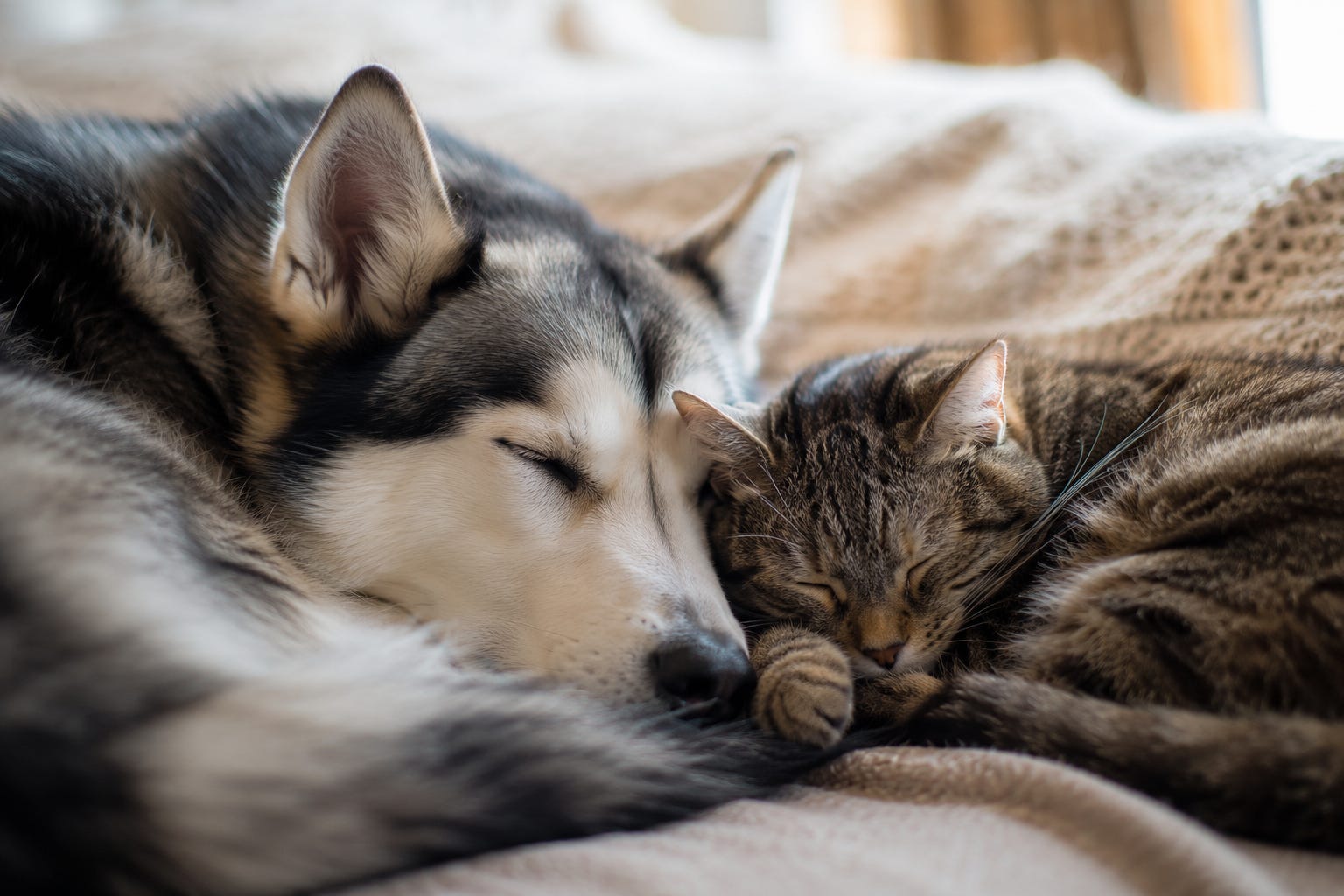
There’s a moment I can’t stop thinking about. A family applied their dog’s flea and tick medication. The kind you squeeze between the shoulder blades. They didn’t know to worry. Nobody told them to. Their cat and dog were best friends, the kind that curled up together every night, nose to nose.
The cat died.
Not from disease. Not from age. From a medication sitting on the dog’s coat. That is how toxic this is. Cats don’t have the liver enzyme that breaks permethrin down, so the dose that’s routine for a dog is lethal for a cat, and all it takes is contact. Grooming each other. Sharing a couch. Curling up the way best friends do.
I spent years running a pet services business. Thousands of dogs moved through our care. What I watched over that time changed how I think about every product we put on and in our animals.
Half the dogs in our care were on behavioral meds.
Not for illness. For anxiety. Reactivity. The kind of symptoms that, looking back, tracked closely with the rise of systemic flea and tick preventives.
Nobody was connecting the dots. The vet visit for anxiety happened months after the flea medication. The behavioral changes started subtle. Lethargy. A little off. Not quite themselves. Then worse.
And the seizures. I watched healthy dogs have their first seizure. No history, no prior neurological anything. When you start asking questions, when you trace it back, the timeline keeps landing in the same place.
I am not the only one who noticed.
This part isn’t anecdotal.
The FDA issued a formal safety alert on this class of drugs in 2018, then updated it in 2019 and again in 2021.
The drugs are called isoxazolines. You know them as Bravecto, NexGard, Credelio, Simparica. They work by attacking the nervous system of the parasite, blocking nerve signals until it’s paralyzed and dies. The mechanism works.
Here’s what’s also true. These are neuroactive chemicals, and they circulate systemically through your pet’s bloodstream. Your dog or cat becomes, functionally, a walking pesticide. The FDA’s own post-marketing data confirmed what a lot of pet parents already suspected: muscle tremors, loss of coordination, and seizures, including in animals with no prior neurological history.
Then came Project Jake, a survey of veterinarians and pet owners. Of the dogs given a flea treatment, two out of three experienced an adverse event. Muscle tremors, loss of muscle control, seizures, death. The serious events came in higher than the FDA’s own reported numbers. And data from outside the US showed seven to ten times more seizures and deaths than what was being reported here.
If you have a fellow pet owner who gives a monthly chew without a second thought, this is the part to send them.
The researchers found something else worth sitting with. They couldn’t identify a pattern. Not breed, not age, not a clean genetic marker. The reactions appear, for most animals, to be unpredictable. Which means there is no reliable way to know which dog is next.
The drug doesn’t do its job and leave.
A study published in early 2026 in Environmental Toxicology and Chemistry followed dogs and cats given these treatments and measured what came out the other end.
The compounds were still detectable in the animals’ waste well after the labeled treatment window closed. In some animals, months after. These drugs have long half-lives by design, lotilaner around 30 days, sarolaner up to 41 days in cats. They linger. The liver and the kidneys are processing them the entire time.
The study’s actual alarm was environmental. The residue passing through pets in trace amounts is potent enough to threaten the insects that break down waste and keep soil alive. Dung beetles. Flies. The unglamorous workforce of a functioning ecosystem.
Read that again and ask the obvious question.
If the trace amount a dog excretes is strong enough to kill the insects that touch it, what is the full systemic dose doing to the animal carrying it twelve months a year? The study didn’t measure that. But the question is fair, and it is the question almost nobody is asking out loud.
The cat problem is its own emergency.
The permethrin in topical dog products, the spot-on treatments for the back of the neck, is lethal to cats. Not in large doses. In any dose.
Cats lack the liver enzyme that metabolizes it, so it builds up fast. Symptoms can appear within hours: tremors, seizures, fever. Untreated, death within hours.
The most common way this happens is not someone applying a dog product to a cat. It’s exactly what happened to the family I told you about. The cat and the dog shared space. That was all it took.
Emergency treatment, when it works, means up to three days of hospitalization. The bill runs from a few hundred dollars to several thousand. There is no antidote. Treatment is supportive care while the body fights to survive a thing that never should have happened to it.
If you think your pet has been exposed, this is an emergency. Call your veterinarian or the ASPCA Animal Poison Control Center at (888) 426-4435 right now. Minutes matter.
Nobody is telling you this at checkout.
The conversation usually goes: What are you using for flea and tick? Here’s the monthly chew. See you next year.
That is not a knock on your vet. It’s a systems problem. A twelve-minute appointment doesn’t leave room for a cumulative-toxic-load conversation, and most pet parents don’t know to start one.
But sit with this. Every monthly dose adds to a total, and the flea chew is only one line on the bill.
Think about the ordinary day in your home. The dryer sheet and the scented detergent that leave a residue in the bedding your dog sleeps in face-down. Tide, Downy, the rest. The fabric softener built to stay in the fibers. The disinfecting spray and wipes you run across the floor and counters, the ones full of quaternary ammonium compounds, Lysol and nearly every “kills 99.9%” product beside it. The plug-in air freshener and the can of Febreze misting a fine fragrance load into the air at the exact height a cat breathes. The flea medication, the lawn treatment, the flame retardants in the dog bed, the processed kibble, the plastic bowl.
We were sold all of it as clean. Fresher. Better. And here is the part nobody mentions: your animal lives closer to the residue than you ever do. Paws on the treated floor, then into the mouth. Belly on the laundered blanket all night. Lungs at carpet level, where the heavy compounds settle. You get the marketing version of clean. They get the dose.
None of this is one dramatic poisoning. It’s a load. The liver and the kidneys process all of it, all the time. When no obvious symptom shows up, we assume everything is fine.
That assumption is the part worth examining.
What I actually do.
I rotate proteins and feed fresh, species-appropriate food. I support the body’s own detox pathways: milk thistle for the liver, clean filtered water, moisture-rich food, less chemical exposure across the board.
For parasites, I don’t reach for a systemic chew first. I work a layered, lower-toxicity system, and I add the heavier tools only when the actual risk calls for it. Here’s the order I run it in.
First, I size up the real risk. Where do we live. How does this animal spend its days. What’s the tick-borne disease pressure in this exact area, this season. A city lap dog and a rural dog who runs a wooded property do not need the same protocol, and pretending they do is how every animal ends up on the same monthly pill regardless of whether it needs one.
Then, Wondercide on the pet and around the home. It’s a cedar and essential-oil spray that works the opposite way from the chew. Nothing goes into the bloodstream. It kills and repels on contact, on the coat, on the bedding, on the floors. The woman who founded it did so after her own dog got sick and her vet suspected the conventional flea and tick meds, the same instinct that runs through everything I write here. The honest tradeoff: it’s more work than a once-a-month pill. You reapply every few days and before heading anywhere high-risk, and you treat the environment, not just the animal. Convenience was never the thing keeping our pets safe. Intention is. The full line, including the yard and home formulas, is on their storefront.
Hypochlorous acid spray on the bedding. This is the same gentle, well-tolerated compound your own body makes to fight infection. I use it on bedding and surfaces, not on the animal, to keep their environment clean without the harsh disinfectants that just add to the chemical load we’re trying to bring down.
And plants, used with judgment. Several genuinely pet-safe herbs double as natural pest repellents and are worth growing freely: rosemary, basil, sage, thyme, lemon balm, and catnip, which is one of the more effective natural mosquito deterrents there is. A few others, lavender, lemongrass, and citrus among them, repel pests by scent but carry a toxicity risk if a pet actually eats them, and lavender in particular is hard on cats. Those belong as outdoor or perimeter plantings, away from where a chewer or a cat can graze. Used that way they earn their place. Used carelessly they don’t.
Around those outdoor plantings I work in food-grade diatomaceous earth, which handles fleas, ticks, and other crawling pests mechanically rather than chemically. One caveat that matters: the fine dust can irritate lungs, pets’ and yours. Apply it lightly, let it settle, and keep animals off until it’s no longer airborne. Food-grade only, never the pool-filter kind.
In high-risk seasons and high-risk areas, I have a different conversation, because there are real situations where the danger of tick-borne disease outweighs the danger of the medication. That math is legitimate and I respect it. A repellent spray is a first line, not a guarantee against Lyme in a hot zone. Know which situation you’re in.
What I don’t do is hand my animal a monthly systemic neuroactive compound on autopilot, twelve months a year, without asking whether this animal, at this time, in this place, actually needs it.
The question worth bringing to your vet.
Not should I stop all parasite prevention. That’s the wrong question.
The right one: what is my pet’s actual risk, right now, given where we live, how they spend their days, and their own health history? And if we do use a chemical preventive, what can we do to support the body that has to process it?
A good integrative vet will welcome those questions. Your vet may simply never have been asked them. Ask anyway.
The cat who died never had the chance.
If you don’t have an integrative vet, or you want a second set of eyes on what you’re putting on and in your animal, that’s what the Second Opinion is for. A 45-minute call and a written protocol built around your pet, your environment, and your real risk level. Not a generic handout. A plan for the animal in front of you.
“Wellness is not just the absence of disease. It is actually recognizing that we can make intentional lifestyle choices on a daily basis that ultimately create abundant health.” — Dr. Karen Becker
That sentence is the north star of Integrative Pet Parent and of every Second Opinion I write. The animals we love can’t make those choices for themselves. We make them, on their behalf, every single day, in the small decisions we’ve been taught to make on autopilot.
Less convenience. More intention.
This same principle, less convenience and more intention, runs through everything I write at The Jenn Files, where I cover business, money, resilience, and grit. The way we care for the animals we love reflects the same truth as the way we build anything that lasts: the convenient default is rarely the thing that holds.
Sources
FDA Animal Drug Safety Communication, Isoxazoline Flea and Tick Products (issued 2018; updated 2019 and 2021), fda.gov
Palmieri et al., “Survey of canine use and safety of isoxazoline parasiticides” (Project Jake), Veterinary Medicine and Science, June 2020
Berny, España, Auré, Cado, “Prolonged fecal elimination of isoxazoline antiparasitic drugs in dogs and cats: is there a risk for nontarget species?”, Environmental Toxicology and Chemistry, 2026, DOI: 10.1093/etojnl/vgaf285
“Pharmacology and toxicology of veterinary isoxazolines: a review,” PubMed, 2026
International Cat Care, “Permethrin Poisoning,” icatcare.org
PetMD, “Flea and Tick Medicine Poisoning in Cats,” petmd.com
Links may include affiliate links. I only point to items I actually use on my own animals.
