

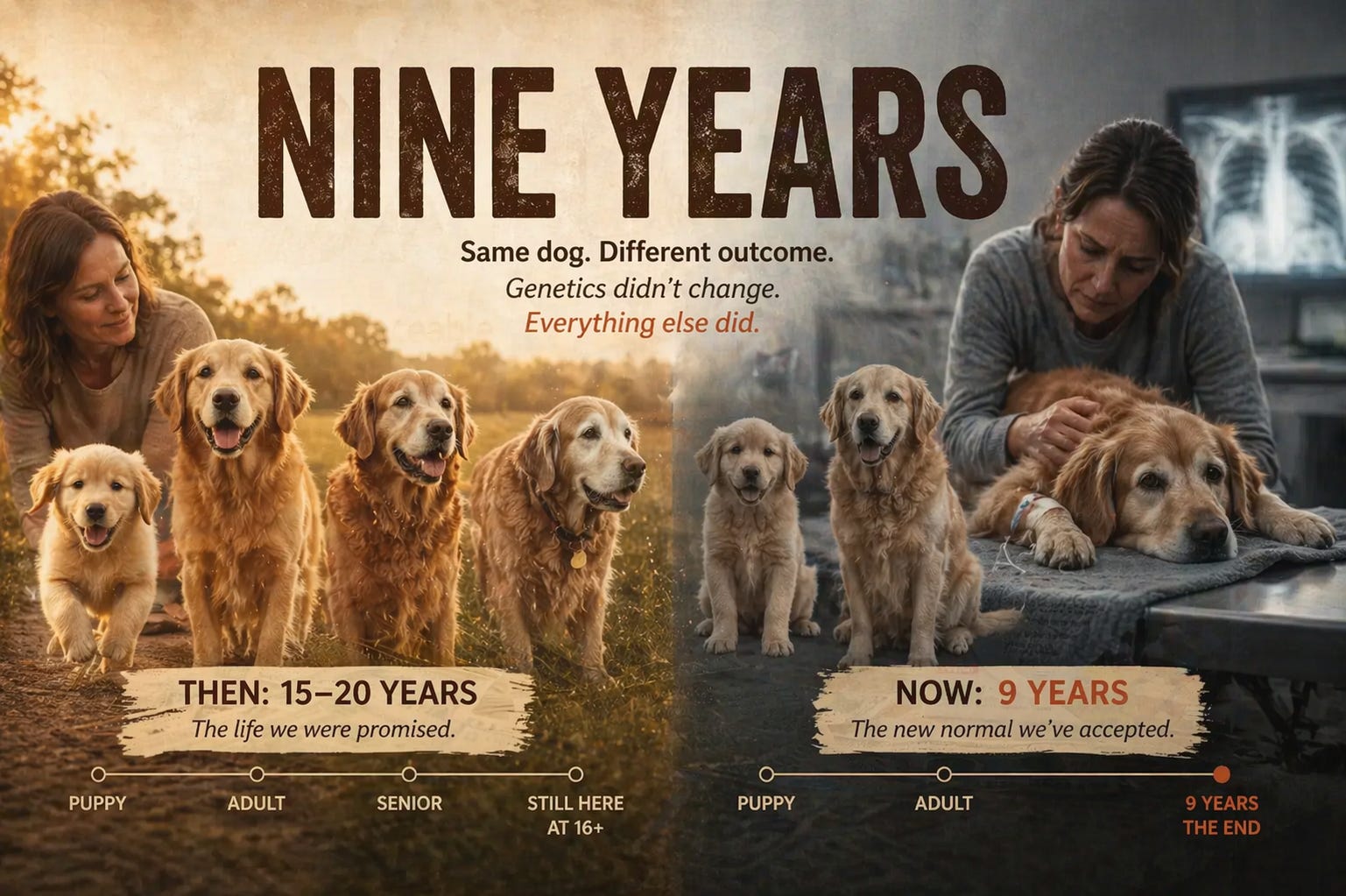
Dogs used to easily live to fifteen. Eighteen. Many of them made it to twenty.
Every one of us over forty remembers that dog. The neighbor’s lab who was still walking the block at sixteen, thriving. The family golden who was there from kindergarten through college. The rescue mutt who just kept going.
That is not nostalgia. That is the baseline.
The baseline has collapsed.
Nine Years
The Morris Animal Foundation enrolled more than three thousand Golden Retrievers in 2012 to figure out why this breed, loved by millions, was suddenly dying so young. The study is still running. So far, roughly three out of every four deaths have been cancer.
The median age at death is 9.4 years.
Nine years. And we have somehow started calling twelve “a long life.”
Here is what makes it worse.
In 1988, a University of Pennsylvania health study did not even flag Goldens as a high-cancer breed. By 1999, a Golden Retriever Club of America survey put cancer mortality in American Goldens at 61.4%.
Not over a lifetime of generations. In a single decade.
Goldens are the most studied breed. They are not the only breed affected. Every breed is trending the same direction. Puppies are being diagnosed with cancer. Young dogs are developing autoimmune conditions. Cats in their prime are presenting with chronic gut disease, thyroid collapse, and organ failure that would have been rare a generation ago.
I want you to sit with that for a second.
The biology of these animals has not changed in fifty years. Their genetics are the same. What changed is everything around them. The food. The vaccine schedules. The pharmaceutical load. The environmental toxins. The economic incentives quietly shaping what your vet recommends in the exam room.
And the ownership structure behind all of it.
One company, Mars (the candy bar company), now owns Royal Canin, Pedigree, Whiskas, Iams, Eukanuba, and Nutro on the food side. On the clinical side, Mars owns Banfield, VCA, BluePearl, and Pet Partners, which adds up to thousands of veterinary hospitals across the country. Mars also owns Antech Diagnostics, the lab that processes bloodwork for more than half of all American animal hospitals. The food in your pet’s bowl, the clinic running the exam, and the lab reading the results can all be owned by the same conglomerate. And increasingly, they are.
That is not a theory. That is an org chart.


Same Dog. Different Country.
Here is the piece of evidence that makes the whole thing undeniable.
In the United States, Golden Retriever cancer mortality runs at 61.4% by the 1999 GRCA survey, 65% in a UC Davis necropsy study, and tracking toward 75% in the Morris study as the dogs age out. The trajectory is still climbing.
European studies of the same breed have documented cancer mortality rates between 20 and 39%, with a widely cited 2010 study landing at 38.8%. Half the rate. Same dog.
And Europe is not standing still on this. Researchers such as Dr. Anna Hielm-Björkman at the University of Helsinki have spent years studying the connection between food, environment, toxins, and canine longevity. Entire programs across Europe are investigating what actually extends a companion animal’s life, and what shortens it.
Same dog. Same genes. Different country. Dramatically different outcomes, and dramatically different levels of institutional urgency about fixing it.
Genetics do not change at the border.
Everything else does.
You Know The Feeling
You are sitting in the exam room. Your dog is off and you know it. The vet is telling you the labs look fine. You leave without an answer. You go home. A month later, you are back.
Or your cat has thrown up three times this week and you are being told it is “just a cat thing.” You are not convinced. You are right not to be.
Or your pet has a diagnosis now, and the plan is being handed to you on a half-sheet, and every question you ask gets a version of “let’s just watch and see.”
You know what I am describing because you have lived it.
That feeling is not paranoia. You are seeing what the system is not set up to see. The gut knowing is clinical data. You just have not had anywhere to take it.
Who Is Actually Looking Out for Your Pet
Nine years instead of eighteen is not an accident.
It is the result of a thousand small decisions made on behalf of our pets by people and systems with competing incentives.
Food companies optimize for shelf life and margin. That is why the bag can sit on a pallet in sweltering heat for eighteen months and still be sold as “complete and balanced.”
Vaccine manufacturers optimize for profit, with legal coverage as the convenient justification. That is why the recommended schedule keeps expanding and the boosters keep coming, long after the science on duration of immunity says most of them are unnecessary. It is why a five-pound Chihuahua gets the same rabies vaccine dose as a one-hundred-fifty-pound Great Dane.
Make the math make sense.
Pharmaceutical companies optimize for quarterly earnings. That is why the newest chewable flea and tick product has a warning label most pet parents never actually read. It is also why, during the years I was building a pet care business, I watched more than half the dogs coming into our care that were on some form of behavioral medication. Doggy Prozac for dogs whose behavior was a symptom, not a diagnosis. Nobody found it strange except the people paying attention.
Veterinary corporate chains optimize for appointment throughput. That is why your fifteen-minute visit somehow costs $400 and ends with a handful of prescriptions and no real answers.
None of those incentives are aligned with your pet living a long, thriving life.
The only incentive aligned with your pet living a long, thriving life is yours.
That argument is not abstract. I have seen it play out in real time, in the lives of real pets.
Twenty
One of my earliest clients was a senior rescue named Simie. I was just starting to build my pet care business, starting to ask the kinds of questions that would eventually become this practice. She came into our care recently rescued, still recovering from mange, withdrawn and timid and uncertain of humans and who if anyone could be trusted.
By every conventional measure, her trajectory was already written. Older rescue. Rough history. Limited runway. The world had decided what her ending looked like before her new mom ever brought her home.
Her mom, a first time pet owner, decided otherwise.
We started working together on what Simie was eating, what she was not, and what she needed. Lightly cooked human-grade food. Targeted supplements. Relentless questioning of what was actually in the bag, regardless of what the marketing promised. We tracked what worked. We adjusted when something did not. We refused to accept that her starting point determined her ceiling.
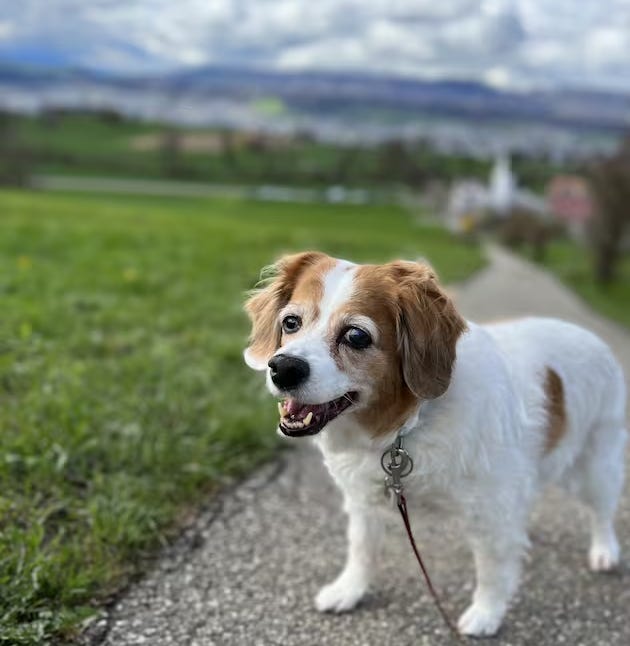
Simie is twenty years old now.
She lives in Zurich with her family, where she was profiled this past year in the Swiss press as one of, if not the oldest living dog in Switzerland.
Same small dog. Same biology. A completely different life than anyone predicted.
That is the entire thesis of this work.
The starting conditions do not have to determine the outcome. A rescue with a rough history can thrive. A pet written off as too old, too sick, or too far gone can surprise everyone. The difference between what is expected and what is possible is almost always a pet parent who refused to accept the default and a care plan built with real information.
If you adopted a senior. If you have a pet with a rough medical history. If you have been told there is not much to do.
Especially for you.
Why I Am Doing This
I am Jennifer. I built and exited a seven-figure pet services business. I hold a postgraduate certification in Integrative Pet Health Coaching. I am dyslexic, which is relevant to the work because dyslexic brains read patterns and trends where other people see isolated data points. That is exactly what this work requires.
I am not your veterinarian. I am the person who sits with the bloodwork for several hours after the fifteen-minute appointment ends. A translator. A pattern reader. An advocate.
Integrative Pet Parent is where I write about what is actually happening to our pets and what to do about it. Bloodwork literacy. Species-appropriate nutrition. Vaccine strategy. Environmental burden. The patterns I see working across my practice.
Most of it is free.
If your pet’s labs keep coming back “normal” but something is clearly off, this publication is for you. If you are raising a puppy or kitten and you want to get the foundation right before anything goes wrong, this is for you. If your pet is a rescue, a senior, or a case somebody has already given up on, this is absolutely for you.
Dogs used to live to fifteen. Eighteen. Twenty.
They thrived.
They can again.
If you decide they will.
Sources
Morris Animal Foundation, Golden Retriever Lifetime Study. 3,044 Goldens enrolled 2012–2015. Cohort profile and mortality data published in PLOS ONE. https://pmc.ncbi.nlm.nih.gov/articles/PMC9182714/
Kent, M.S., et al. “Association of cancer-related mortality, age and gonadectomy in golden retriever dogs at a veterinary academic center (1989-2016).” PLOS ONE, 2018. 65% cancer-related death rate in U.S. Goldens. https://journals.plos.org/plosone/article?id=10.1371/journal.pone.0192578
Nelson, B. & Faquin, W. “Retrieving new clues about a dog breed’s ‘insane’ cancer risk.” Cancer Cytopathology, 2024. Three of four U.S. Goldens in the Morris cohort dying of cancer. https://acsjournals.onlinelibrary.wiley.com/doi/full/10.1002/cncy.22899
Golden Retriever Club of America National Health Survey, 1998–1999 (Glickman et al.). 61.4% cancer mortality in American Goldens.
European Golden Retriever cancer mortality data, 2010. 38.8% cancer mortality.
University of Pennsylvania School of Veterinary Medicine Health Study, 1988. Baseline data showing Goldens not flagged as a high-cancer breed.
Mars Petcare corporate holdings. VCA acquisition completed 2017 for $9.1 billion, adding VCA’s veterinary hospitals and Antech Diagnostics to a portfolio that already included Banfield, BluePearl, Pet Partners, and pet food brands including Royal Canin, Pedigree, Whiskas, Iams, Eukanuba, and Nutro. Antech processes bloodwork for more than half of US animal hospitals. https://www.mars.com/news-and-stories/press-releases/vca-acquisition https://news.vin.com/default.aspx?pid=210&Id=9297861