

She is two years old. The cough started a week ago and the household has not slept since. The vet swabbed her for Bordetella, confirmed it, sent you home with doxycycline and a printout of dosing instructions. You are dosing her on schedule. She is starting to feel better. Nobody at the appointment said a word about her gut.
He is seven. The skin infection finally cultured out and the lab named the organism. He is on his third course of antibiotics this year for the same recurring issue. Each course works. Each course is followed, three or four months later, by another infection. Nobody has asked the question of why this keeps happening.
He is small, and he is on six medications at once. The tick bite cracked his system open. The doxycycline is necessary. So are the four other prescriptions. His liver enzymes are climbing. His gut, which was already compromised before any of this started, is now being acted on from every direction simultaneously.
Three different dogs. Three different antibiotic situations. One identical question that nobody at the appointment is asking.
If you have ever filled an antibiotic prescription for your dog and walked out of the appointment wondering whether you should be doing more for them while the medication does its work, this is the article that answers that question.
What antibiotics actually do to a dog’s gut
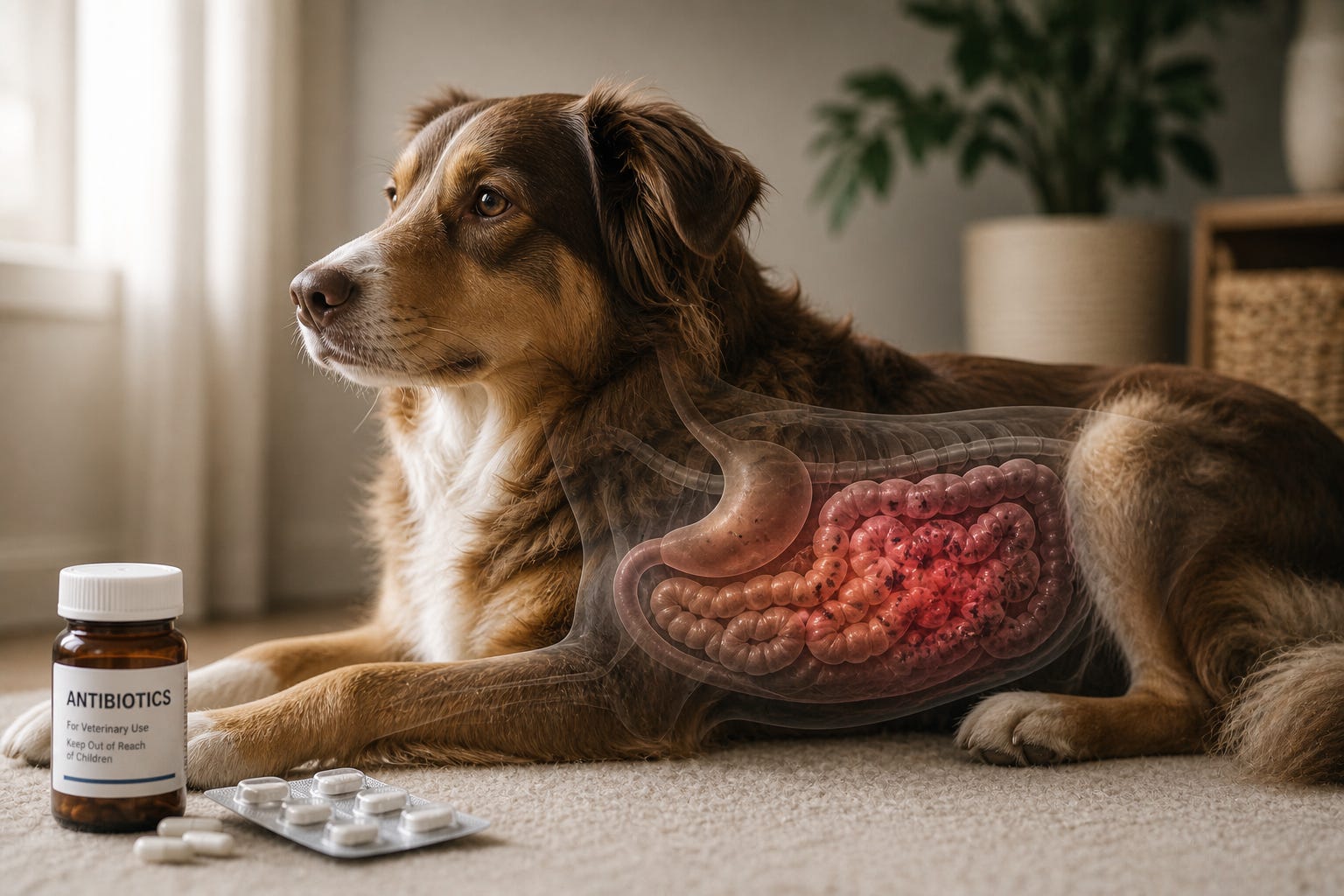
Antibiotics do not target the bacteria you want them to target with anything resembling precision. They kill bacteria across categories. The pathogen that is making your dog sick. The beneficial populations in the gut that train the immune system. The keystone species that keep opportunistic yeasts in check. The strains that produce the short-chain fatty acids the intestinal lining depends on for fuel.
A single course of a broad-spectrum antibiotic can shift the composition of the gut microbiome for months. Research suggests certain bacterial populations never fully recover to their pre-antibiotic baseline without active intervention. The diversity collapses. Keystone species that took years to establish are wiped out in days. Opportunistic organisms that were being held in check, particularly Malassezia and Candida yeasts, suddenly have room to expand.
This is not a side effect. It is the mechanism. The collateral damage is part of how the medication works, not a flaw in the design. For the acute infection, that tradeoff is worth making. Untreated bacterial infection is dangerous. The antibiotic earns its place.
What goes unaddressed in most veterinary appointments is what happens to the gut while the medication does its work, and what to do about it.
If you have not read the foundational article on why approximately seventy to eighty percent of your dog’s immune system lives in the gut, start there. This article assumes that foundation.
Why the appointment that hands you the antibiotic rarely covers what to do for the gut
The conventional veterinary appointment is structured around throughput. Fifteen to twenty minutes for the visit, the diagnosis, the prescription, the discharge instructions, and the next dog already in the lobby. There is no slot in that workflow for a longitudinal conversation about microbiome support. There is no diagnostic code for it. The bottle gets handed to you with instructions on dosing, timing relative to food, and signs of adverse reaction. What it does not include is what to do for the seventy percent of the immune system the medication is acting on at the same time.
That is not a failure of any individual veterinarian. It is a structural feature of the system. The vet who prescribed the antibiotic made the right call for the immediate clinical problem. The pet parent who carries the prescription home now has a different job: protecting the foundation while the medication does its work.
That job has a protocol. It is not exotic. It is not expensive. And it is not optional if you want your dog’s gut to recover well on the other side of the course.
What to do during the antibiotic course
The protocol below works whether your dog is on a five-day course or a three-month course. The principles are the same. The implementation scales to the duration of the prescription.
Add bone broth to every meal, starting the day the antibiotic does. Human-grade, no onion, no leeks. Kettle & Fire and Brutus Broth are both clean and widely available. The collagen and gelatin are the literal building blocks of the mucosal tissue the antibiotic is stressing. The glycine is directly hepatoprotective, which matters when the liver is metabolizing the medication. Pour a few tablespoons warm over whatever your dog is eating right now.
Start a quality probiotic, but time it correctly. This is the single most-asked question in integrative practice, and the answer matters. Probiotics taken at the same time as the antibiotic get killed by the antibiotic. The strains never reach the gut. The dose is wasted. The window that works is at least two to four hours apart from the antibiotic dose. If your dog gets doxycycline at 8 AM and 8 PM, the probiotic goes in at noon. If your dog is on a once-daily antibiotic, give the probiotic at the opposite end of the day.
The two products with the strongest clinical track record in integrative veterinary practice are ProBenz-VM by VDI Lab (a complete formulation that combines probiotic strains with prebiotics, digestive enzymes, and L-glutamine in one product) and Primitive Probiotics by Dr. Karen Becker (canine-specific strains sourced from healthy domestic dogs and wild wolves, including Saccharomyces boulardii, the yeast organism specifically researched for protection during antibiotic courses).
Add plain whole-milk kefir as an evening ritual. A few tablespoons, every day, with a small handful of frozen blueberries on top. Goat kefir is the first choice if you can find it. Smaller fat globules, lower lactose, A2 casein, easier on a recovering gut. Redwood Hill Farm makes a clean goat option available at most natural grocers. Plain whole-milk cow kefir is the strong alternative if goat is not accessible. Lifeway and 365 are both clean and widely available. Kefir delivers living cultures in a food matrix the body recognizes, including beneficial yeasts that no probiotic capsule can replicate. The kefir is not redundant with the probiotic supplement. It works through different strain families and a different delivery mechanism. Both belong in the protocol.
Filter the drinking water. Chlorine and fluoride in municipal tap water continue to suppress microbial populations between antibiotic doses. A basic pitcher filter removes both for under forty dollars. This is the single highest-leverage environmental change you can make for the lowest cost.
Switch to filtered water for any bone broth made at home, too. The same chlorine that suppresses gut bacteria in the bowl will suppress them in the broth. Use the filtered water at every step.
Finishing the bottle is not the finish line.
The dog who comes back to the vet six months later with chronic ear infections is often the same dog who was on antibiotics earlier in the year. The dog whose skin issues will not resolve no matter how many topicals get applied is often the same dog whose microbiome got hollowed out by a course of doxycycline two years ago that nobody supported. The dog whose gut never quite came right after the puppy parvo treatment is, fifteen years later, still showing the consequences.
The microbiome’s recovery work begins the day the medication ends. What you do in the next four to six weeks matters as much as what you did during the course itself.
What to do after the course is finished
The work does not stop the day the bottle is empty. The microbiome needs active support for weeks to months after the antibiotic ends, depending on the duration of the course and the state of the gut going into it.
Continue the probiotic for at least four to six weeks past the last antibiotic dose. This is the most-skipped step. Pet parents finish the antibiotic, return the supplement to the cabinet, and miss the most important window for actual repopulation. The probiotic’s job during the course was protective. Its job after the course is colonization. Those are different mechanisms with different timelines. Give the gut the runway it needs.
Continue bone broth and kefir indefinitely. These are not antibiotic-specific interventions. They belong in your dog’s daily routine forever. The post-antibiotic period is the moment to install them as habits if they were not already part of the rhythm of your household.
Add medicinal mushrooms once the gut is stable, not before. Turkey tail in particular has direct research support for gut microbiome diversity. Real Mushrooms makes a pet-specific turkey tail product that is fruiting-body only, with full transparency on sourcing. Introduce three to four days after the antibiotic course ends, starting with half the recommended dose for a week, then building to full dose. Mushrooms work through immune modulation, not direct repopulation, so they layer on top of the probiotic foundation rather than replacing it.
Consider colostrum if the course was long or the dog was already compromised going in. Bovine colostrum delivers immunoglobulins, lactoferrin, and growth factors that directly support gut lining repair and immune cell function. RX Vitamins makes a first-milking pet-formulated colostrum that is the right answer for most dogs. Four Leaf Rover offers a grass-fed New Zealand option for pet parents who want premium sourcing.
Watch the stool. A 2 on the seven-point veterinary scale (firm, segmented, holds shape) is the marker of a recovering gut. Mild loosening in the first week post-antibiotic is normal as the microbiome reshuffles. Persistent loose stool, mucus, or undigested food past two weeks is the signal that the protocol needs adjustment, not abandonment.
What to look for in the months that follow
The signs of microbiome damage do not always appear during the antibiotic course. They appear weeks or months later, after the protective effect of beneficial bacteria has eroded enough for the consequences to surface. This is why the connection is so often missed at the next vet appointment.
The patterns to watch for: chronic ear scratching that did not exist before the course, particularly if it pairs with a yeasty smell or brown discharge. Itchy paws and obsessive licking, especially between the toes. Recurring skin infections that respond to topical treatment and then return within weeks. Loose stool that comes and goes without obvious dietary trigger. Increased anxiety or compulsive behavior, often missed because pet parents do not connect behavioral changes to gut events that happened months earlier.
If any of these appear in the weeks or months after an antibiotic course, the antibiotic is part of the story. The gut work to address it is the same protocol described above, intensified and continued longer.
When the antibiotic is unavoidable and repeated
The dog with chronic UTIs cycling through course after course of antibiotics. The dog with chronic skin infections back on doxycycline for the third time this year. The dog with periodontal disease being managed on long-term antimicrobials. These are the situations where microbiome damage compounds, and where the conventional protocol of “treat the infection, prescribe the antibiotic, repeat in three months” is masking a deeper question that nobody is asking.
The deeper question is: why does this keep happening? Recurring bacterial infection in a healthy dog is rare. Recurring bacterial infection in a dog whose microbiome has been depleted by previous antibiotic courses is predictable. The cycle is self-perpetuating. Each course suppresses the bacterial populations that were supposed to keep the next infection from taking hold.
If your dog is on the third or fourth course of antibiotics in a year, the conversation that needs to happen is not just about this prescription. It is about the upstream pattern. That conversation is what integrative care is built for.
The North Star
“Wellness is not just the absence of disease. It is actually recognizing that we can make intentional lifestyle choices on a daily basis that ultimately create abundant health.”
— Dr. Karen Becker
That is the foundation of everything I do at Integrative Pet Parent and the lens I bring to every Second Opinion. Wellness is not a single decision. It is a daily practice. Food, movement, supplements, stress, environment. My job is to help you choose with clarity and confidence.
If your dog is currently on an antibiotic, or just finished one
You are not too late. The microbiome does not punish you for finding this article in week three instead of week one. It just needs you to start now.
A Second Opinion is what I built for exactly this moment. You bring the antibiotic history, the current medications, the food they are eating, and the patterns you have been noticing. I bring the integrative lens. Pattern recognition, root-cause investigation, and a complete plan you can actually follow. The first 100 founding members receive a complimentary session valued at $350.
You do not have to figure this out alone.
Further Reading
The voices and research that inform this work, with links for pet parents who want to verify and go deeper.
Dr. Karen Becker, DVM. Board-certified integrative veterinarian, co-author of The Forever Dog with Rodney Habib, formulator of Primitive Probiotics. drkarenbecker.com
Dr. Anna Hielm-Björkman, DVM, PhD. Lead researcher of the DogRisk research group at the University of Helsinki, publishing on the relationship between diet, the microbiome, and chronic canine disease. dogriskhelsinki.fi
Dr. Jean Dodds, DVM. Founder of Hemopet, foremost authority on canine immunology, vaccine response, and the immune consequences of chronic pharmaceutical exposure. hemopet.org
ProBenz-VM by VDI Laboratory. Complete probiotic, prebiotic, enzyme, and gut-lining-support formulation. The clinical foundation product for microbiome restoration in integrative veterinary practice. vdilab.com/product/probenz-vm
Primitive Probiotics by Proactive Paws. Canine-specific probiotic strains including Saccharomyces boulardii, sourced from healthy domestic dogs and wild wolves. Formulated by Dr. Karen Becker. proactivepaws.com
Real Mushrooms (Pets line). Fruiting-body-only medicinal mushroom products with full sourcing transparency. Turkey tail with direct research support for gut microbiome diversity. realmushrooms.com
American Holistic Veterinary Medical Association. Professional directory of board-certified integrative veterinarians by region, for pet parents seeking integrative care. ahvma.org
Why 70% of Your Dog’s Immune System Lives in Their Gut. The foundational article in The Science library, explaining the gut-immune connection this article builds on. Read it here
— Jenn │ Integrative Pet Parent